28 August 2026
The end of average creativity: why brands must escape AI sameness
AI & CREATIVITY / BRAND DISTINCTIVENESS / CONTENT PRODUCTION
When every brand can make polished content, taste becomes the advantage. AI can accelerate production, but distinctive work still needs human tension, evidence and judgement.
By Frédéric De Decker · Trinity
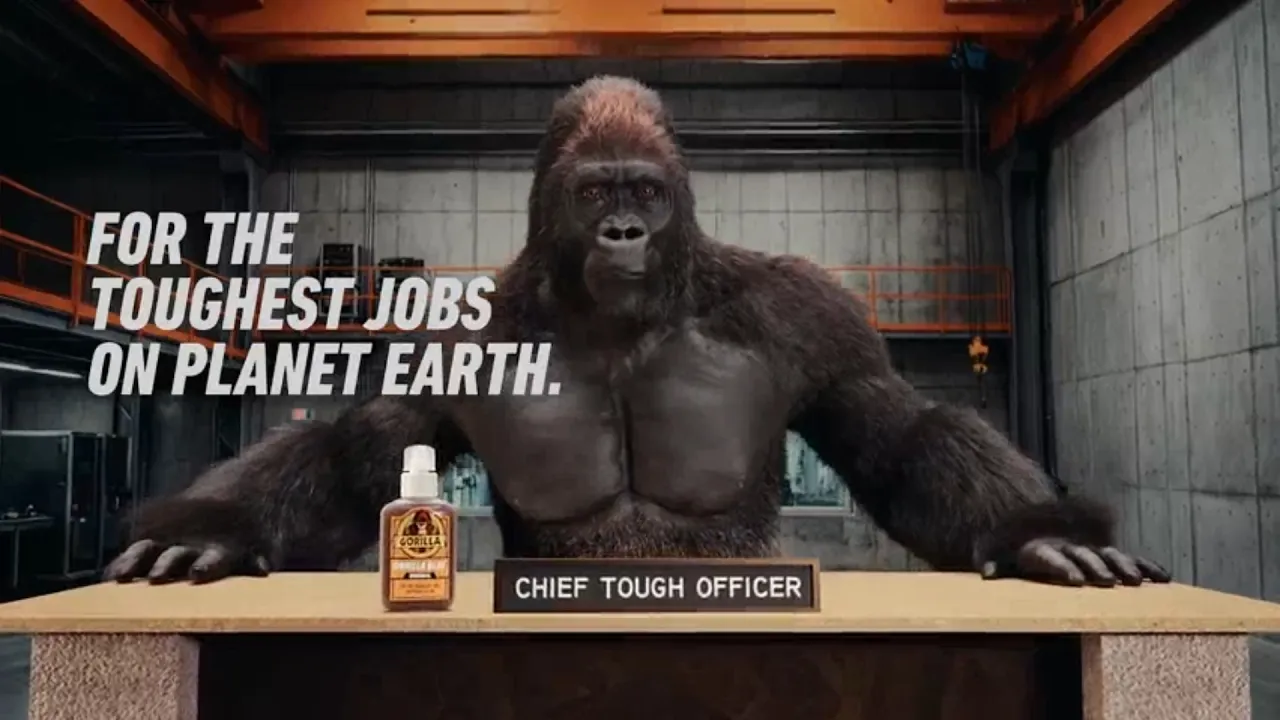
On 13 April 2026, an ad appeared online for a watch nobody could buy.
The film lasts 36 seconds. A boy finds a watch, turns the crown and watches his body jump forward in time. Another turn takes him back. Eventually, the watch reaches an elderly woman and gives her a few seconds of youth.
There is barely any dialogue. Nobody explains the mechanism. There is no product demonstration, which makes sense once you discover that there is no product either.
J. Felipe Orozco made The Watch with Runway. Runway says the film passed 100 million views on Instagram within 48 hours. A few weeks later, it won Commercial of the Year at the first Generated Awards, selected from roughly 1,700 AI-video submissions. [1][2]
The AI was impressive. Yet most impressive AI films leave you thinking about the software. The Watch leaves you thinking about time, which tells us something about where the value is moving as production becomes abundant.
What is AI sameness?
AI sameness is what happens when generative tools make content more polished but less recognisable. The work is competent, quick and perfectly acceptable. It also sounds, looks or moves like everything around it. The problem is not that AI was used. It is that nobody gave it enough specific human material to escape the average.
This post URL doesn’t seem correct.
Polished just got cheap
Marketing spent years trying to make production faster and cheaper. Well, it worked.
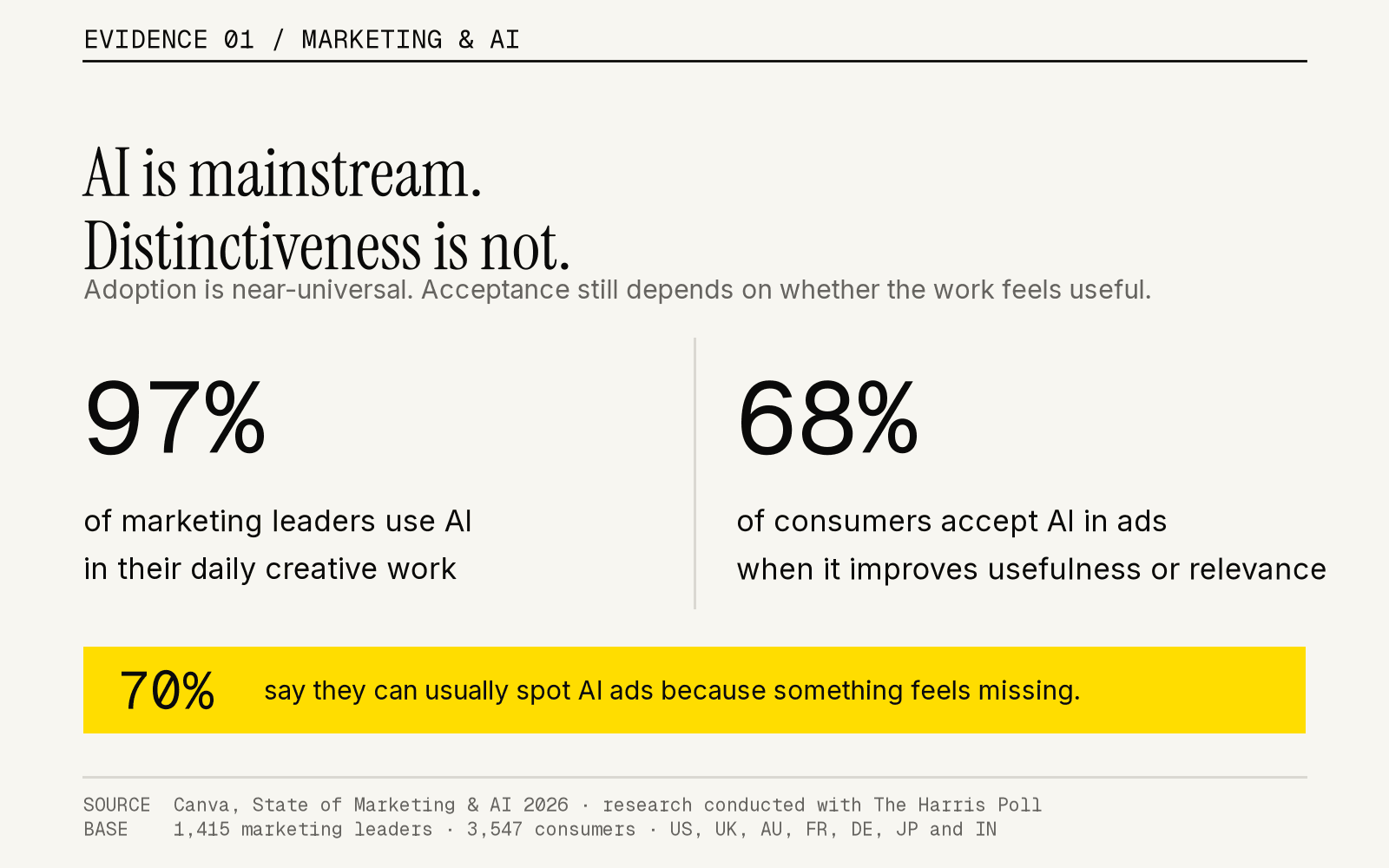
A brand can now produce headlines in batches of twenty, explore visual worlds before lunch and prototype shots that once required a crew, a location and a fairly serious conversation about money. Canva's 2026 State of Marketing & AI report found that 97% of marketing leaders already use AI in their daily creative work. 99% plan to invest more. [3]
This is good news. Smaller companies can test ambitious ideas. Creative teams can explore a direction before committing a production budget. Local work can travel across formats and markets without being rebuilt each time.
It also means a half-formed idea can arrive beautifully lit, correctly punctuated and carrying itself with the confidence of a finished campaign.
Production constraints used to be frustrating. They also filtered things. An idea had to survive a sketch, a discussion and the prospect of spending real money before it reached the public. AI removes much of that friction. It lowers the cost of a good idea and the cost of a forgettable one in exactly the same way.
Professional execution will remain useful, but it is becoming a poor way to tell brands apart. A polished image is no longer scarce. Neither is a competent article or a cinematic-looking shot. Soon, "professional" may tell us little more than whether the tool worked.
Canva's consumer research adds a useful wrinkle. Sixty-eight percent of consumers say they do not mind AI in advertising when it makes the result more useful or relevant. [3] Their response suggests that the technology itself is becoming ordinary. Hollow, generic work still feels hollow and generic, however efficiently it was produced.
When better starts looking the same
In 2024, researchers Anil Doshi and Oliver Hauser asked people to write short stories. Some of the writers received ideas from a generative AI system. The assisted stories were judged more creative, better written and more enjoyable, with the largest gains among the less creative writers. [4]
Then the researchers put the stories next to one another. That is where the shine came off. The AI-assisted work was more similar.
This is an awkward result for brands. A tool can improve the next thing you publish while making the category around you feel increasingly familiar. The work gets better when judged on its own and weaker when judged in the feed where it actually has to compete.
AI is extremely good at plausibility. Give it a category, an audience and a format, and it can produce something that belongs. That is often useful. Stay with the default for too long, however, and belonging turns into blending in.
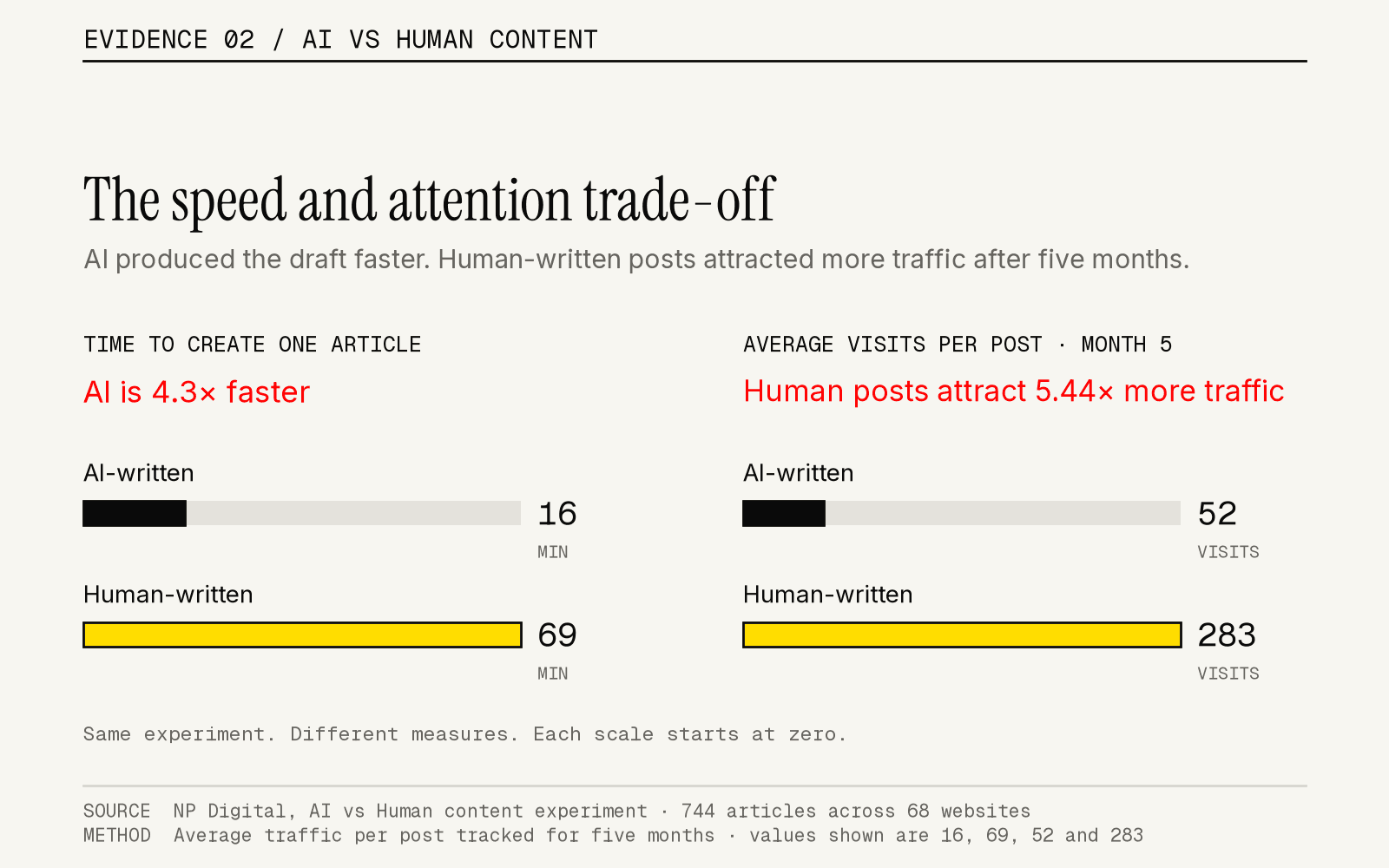
Neil Patel and his team at NP Digital tested a less philosophical version of the problem. They published 744 articles across 68 websites, comparing AI-generated and human-written content. The AI workflow took an average of 16 minutes per article. The human writers took 69. [5]
Five months later, the human-written articles were receiving 5.44 times more traffic. NP Digital's chart puts the month-five average at roughly 283 visits per human-written post and 52 for the AI-generated work. The human content also attracted more traffic for each minute spent creating it. [5][6]
One experiment in SEO content does not settle the argument, and next year's tools will be better. It does puncture a convenient assumption. Saving an hour at the beginning means little when nobody cares at the end.
Patel's own recommendation is sensible: use AI for research, ideas and first drafts, then add the context, accuracy and voice that make the piece worth reading. [5] The dividing line is less about who typed the words than who directed the work.
Taste has work to do
Taste is one of those words people use when they do not want to explain themselves. In a creative review, it has a fairly practical job. You ask for twenty routes. Twelve are competent, five are fashionable and two could carry a competitor's logo without anybody noticing. One makes the room slightly uncomfortable, in a good way. Taste is what helps the team decide whether that route deserves another day of work, or whether all twenty should go in the bin.
Marketing has built plenty of systems to make creative choices safer: guidelines, templates, benchmarks, platform conventions and performance data. Generative AI is the most powerful version of that promise so far. It produces more options before the meeting has finished.
More options do not spare us from choosing. They make weak judgement more expensive because the wrong route can now be produced at extraordinary speed.This changes the work of a creative team. Generating possibilities takes less time. Looking closely, arguing well and rejecting the familiar take more of it. The first image may be perfectly usable and still be the wrong image. The obvious metaphor may communicate clearly and sound like everybody else. A campaign that can wear six competitors' logos is not versatile. It is anonymous.
The constructive answer is stronger creative direction. Set a sharper tension before generating. Decide which category conventions are still useful and which have become camouflage. Ask what the work should make someone notice or feel, and give the team permission to reject competent work when it has nothing distinctive to say.
Start with what the model cannot know
Weak AI workflows often start at the tool. Somebody opens a prompt box and asks what it should make.
A stronger process begins with material the model does not own: a customer conversation that changed your view of the category, the objection your sales team hears every week, a founder's stubborn opinion, a piece of local culture outsiders would miss, an archive, a craft or a set of proprietary data that refuses to fit the accepted story. This material is rarely tidy, which is part of what makes it useful.
We saw this clearly while building articles for HairBeautyHub. Semactic, our SEO and GEO technology partner, helped us identify search gaps, relevant topics and keyword opportunities. AI helped with the drafting. The first results did what generic AI content often does: they covered the subject, followed the structure and sounded as if they could have been written for almost any beauty platform.
So we stopped treating brand voice as a layer to add at the end. We calibrated the articles around HairBeautyHub's values, removed the stock language and added the context a search brief cannot supply on its own. The reporting snapshot for July and August 2026 covered twelve published articles. French-language articles reached positions two and three for nouvelle coupe and nouvelle coiffure, and position nine for cheveux colorés. Dutch-language articles reached position three for haarverzorging zomer, position five for haar herstellen na verven, and position six for both nieuwste kapsels and UV haarbescherming. [7]
Those rankings do not prove that human editing alone produced the result. They do show that search performance and a distinctive voice are not opposing ambitions. The better process is to let data identify the opportunity, let AI accelerate the first build and let people decide what is genuinely useful, accurate and recognisable.
The same principle applies well beyond copy. For an automotive project, Trinity is creating scenes around a vehicle that does not yet physically exist. The team builds and controls the vehicle and environment in Blender, then uses generative AI to complete the visual world. Geometry, camera choices and creative direction remain human-controlled, while AI accelerates production.
That is more than prompting. The model is not being asked to invent the direction and execute it. It is being given a world, a camera and boundaries. The speed comes from AI. The intent still has an owner.
Bring AI in after that and use it aggressively. Explore ten routes. Prototype the strange one before somebody talks you out of it. Translate, storyboard, build visual references and test alternative edits. AI is excellent at making an expensive idea cheaper to investigate.
Then edit with intent. Generate broadly, select carefully and keep a named person responsible for deciding what is true, relevant and worth publishing.
At Trinity, this is why Think. Create. Amplify. matters in an AI workflow. Think establishes the tension and gives the work a reason to exist. Create can draw from a much larger toolbox. Amplify helps the strongest expression travel.
Skip the thinking and AI simply helps a brand produce unwanted work more efficiently.
The sequence is straightforward:
Human tension → AI exploration → human selection → AI-assisted production → human judgement
Does an AI watermark hurt SEO?
The short answer is no: there is no credible evidence that Google penalises content merely because it carries an AI watermark. Google's published guidance focuses on usefulness, accuracy, originality and whether the content adds value. [11]
Content is beginning to carry more information about how it was made. On 2 August 2026, the transparency provisions of Europe's AI Act started to apply. Providers of generative AI systems are expected to make synthetic output detectable through reliable, machine-readable signals, with distinctions between technical marking, visible disclosure and ordinary assistive editing. [8]
The technology is already moving into everyday products. Google says SynthID has been used to watermark more than 100 billion images and videos, along with the equivalent of 60,000 years of audio. Its Gemini verification feature had been used 50 million times by Google I/O 2026. [9]
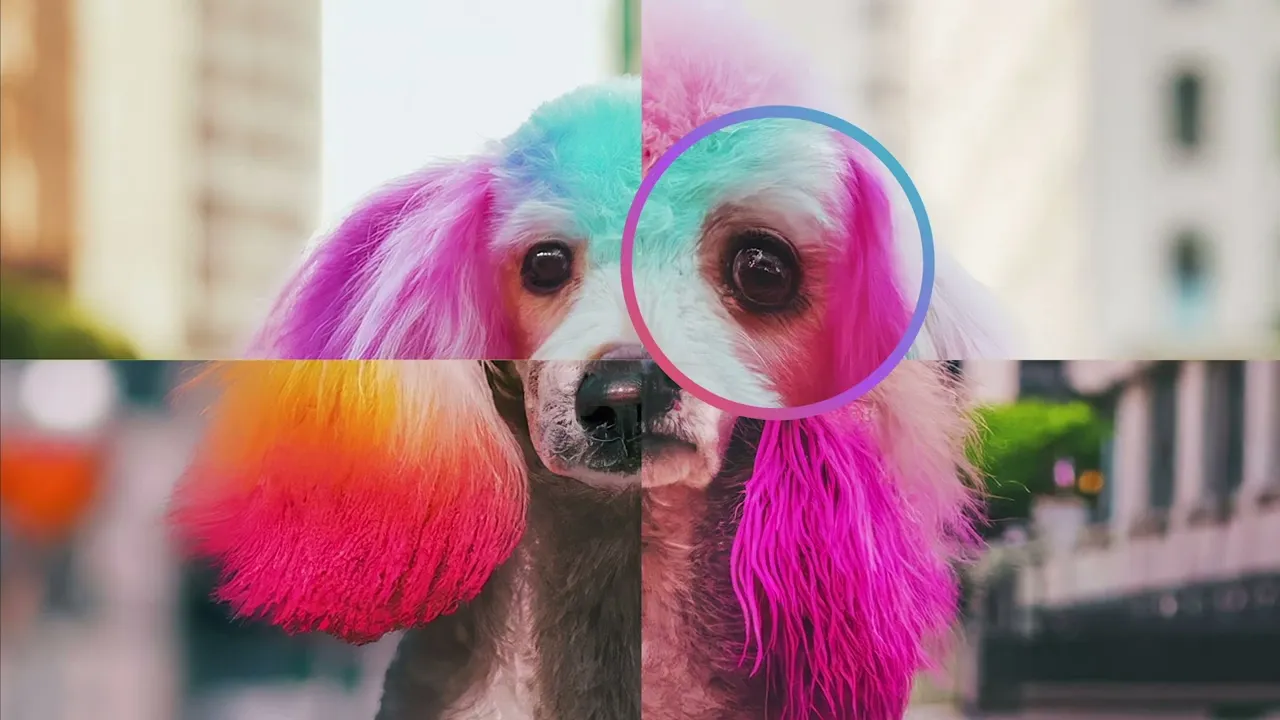
A watermark, Content Credentials and an AI detector are different things. SynthID embeds an imperceptible signal in supported media. Content Credentials attach signed information about a file's origin and editing history. A detector tries to infer where content came from after the fact. None of them can tell us whether the content is accurate, useful or legally sound. [10]
Brands should preserve relevant provenance and make the human contribution easier to see by showing the expertise, access, evidence and judgement that shaped the work. A technical signal may identify the tool, but it cannot make the result interesting.
Add provenance as the final step:
Human tension → AI exploration → human selection → AI-assisted production → human judgement → provenance preserved
The Trinity Anti-Sameness Test
The quickest way to expose generic creative work is to remove the logo. We call this the Trinity Anti-Sameness Test.
Ask the following questions before publishing:
Could one of our three closest competitors publish this unchanged?
Is there a real human tension behind the idea, or have we simply selected a topic?
Does the work contain something the model could not know without us, such as data, access, expertise, lived experience, an archive or a genuine point of view?
Can we name one deliberate creative choice that a generic prompt would probably not have made?
Did we use the extra options to reject more work, or merely to publish more of it?
Is AI helping us express an idea we already care about, or supplying one because we arrived empty-handed?
Would we be comfortable showing the audience exactly how AI was used?
Would the work remain interesting if nobody mentioned AI at all?
An uncomfortable answer is useful. It tells you where the work is still thin. Several uncomfortable answers mean the problem began before the prompt.
Go back to the input. Find the customer observation, disagreement, piece of evidence or cultural detail that gave the idea its edge. If there is nothing to return to, more generation will only decorate the absence.
Average creativity will look better than ever
Every important media technology makes yesterday's technical miracle ordinary. Desktop publishing opened up layout. Digital cameras changed image-making. Smartphones put a studio in everyone's pocket.
Generative AI goes further because it makes execution itself widely available. This is exciting, and it should make brands a little nervous.
When execution was difficult, the ability to produce could set a company apart. As it becomes easier, the advantage moves towards observation, cultural understanding and the judgement to leave certain ideas unmade.
Average creativity is unlikely to disappear. If anything, it will look better than ever.
Feeds will become fuller. Images will become cleaner. Video will become cheaper. None of that guarantees attention. A brand still has to notice something worth saying and say it in a way that feels like its own.
The Watch is a useful example because its AI origins explain how the film was produced, but they do not explain its appeal. The film found an emotion people already understood and gave it a simple mechanism. Some reposts did not mention AI at all. The story had outgrown the demonstration. [1]
That should be the ambition. Use the technology fully. Keep the judgement visible. Give the work enough of your own experience, taste and point of view that somebody could recognise it before the logo appears. In an environment where trust is increasingly hard-won, clarity and provenance are part of the creative work too. We explored that tension further in what brands can learn from the mechanics of fake news.
At Trinity, we are building creative and marketing systems in which AI increases the range of what can be made without sanding away the point of view. The practical question is no longer whether AI belongs in the process. It is whether the process still leaves enough room for a brand to belong to itself.
About the author
Frédéric De Decker is co-founder and COO of Trinity. A producer with more than ten years of experience in content and video production, he has worked on projects ranging from interviews to large advertising films, with productions winning multiple festival awards. He leads Trinity's hands-on exploration of generative AI and automation, testing new models and translating them into practical production workflows.

